


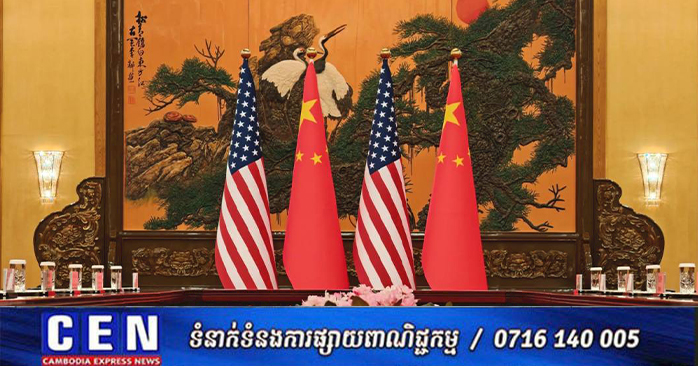
According to the latest figures from the Chicago Council on Global Affairs, more than half of American people believe the United States should pursue friendly cooperation and engagement with China. More notably, Democrats have long leaned toward engagement with China, while support among Republicans has climbed by 10 percentage points within one year, hitting its highest level since 2019.
From September 23 to 25, President Xi Jinping paid a state visit to the United States. The two heads of state exchanged state visits within six months, setting rules for major‑country relations —building a constructive China‑US relationship of strategic stability. This means positive stability with cooperation as the mainstay, sound stability with well‑managed competition, normal stability with controllable differences, and enduring stability promising peace.
From “Decoupling” to “Re‑engagement”: The Path of Confrontation Is Unworkable
In 2017, the U.S. National Security Strategy redefined China as a “strategic competitor”. The 2020 Strategic Guidance further framed the relationship as “great‑power competition”, and a hard‑line stance toward China became a bipartisan consensus in Washington.
After the Cold War, the United States’ “engagement strategy” aimed to bring about change through integration. Yet China embraced the world while forging its own path. Behind China’s development miracle lies its confidence in its own path. While the United States reaped dividends from this engagement, it did not see the “change” it had expected, rendering its engagement strategy a failure. Washington then opted for stepped‑up pressure. From the trade war to technological blockades, from entity lists to the “small yard, high fence” strategy, the Trump administration ultimately pushed for “decoupling”, seeking to cut China out of the U.S.‑led global system. The Biden administration carried forward this approach, imposing layer‑upon‑layer restrictions in chips, artificial intelligence and advanced manufacturing.
Years on, the outcome has disappointed its designers. Technological containment has failed to contain China; instead, it has spurred accelerated breakthroughs in high‑end manufacturing, aerospace, new‑energy industries, military equipment and other fields. From fifth‑generation fighter jets and aircraft carriers to the Beidou satellite constellation and large‑scale AI models, China has moved from following to catching up, and even taken the lead in a number of cutting‑edge areas. Put plainly, the pressure of being “held back” has often accelerated China’s drive for independent innovation.
At the same time, the United States is witnessing shifts in its global standing. The Ukraine crisis drags on, conflicts in the Middle East resist resolution, and tariff policies have drawn widespread pushback from European and Asian allies. Europe’s awareness of strategic autonomy is rising, and the Global South refuses to take sides. The U.S.‑dominated unipolar order is loosening. Under such circumstances, a head‑on confrontation with a nuclear power and the world’s second‑largest economy would, even with partial gains, drain the United States’ capacity to uphold its global hegemony.
More practically, American business communities have already voted with their feet. Seventy‑five percent of U.S. firms operating in China plan to keep investing in China in 2026. China‑U.S. bilateral goods trade in the second quarter rose by 13.7 percent year‑on‑year. Enterprises seek orders, profits and markets; voters want stable prices, jobs and prosperity. Political slogans must ultimately bow to the realities of economics.
The Balance of Power Is the True Decisive Factor
The so‑called bipartisan consensus for engagement is less a spiritual awakening than a response to hard realities.
It is not that fewer Americans see China as a threat. Rather, a growing number of U.S.
elites have come to realize that confrontation with China brings no gains for the United States; decoupling would impose costs on American businesses and consumers; cornering China would speed up the formation of two parallel systems, ultimately undermining the foundation of the U.S.‑led international order. Managing competition through engagement and controlling differences through communication have become the least costly and risk‑minimizing option.
In other words, the real driver behind Washington’s shifting attitude toward China is China’s continuous rise in strength, which has turned “hard confrontation” from a viable option into a losing proposition. The arrogance of former President Obama, who declared that China would never be allowed to sit at the rule‑making table, gave way to the pragmatism of the Biden administration, which sought to build “guardrails against conflict”. Today, both parties are quietly returning to engagement. Behind this curve lies the same calculation: China’s scale and resilience have outstripped the old‑script expectations.
It has been only a few short years since “crackdown and containment” was an ironclad bipartisan rule, and now “engagement and cooperation” has quietly become a cross‑party consensus. This shift appears to be a swing in public opinion, yet it is in fact a return to realism. It is not that Americans have suddenly grown friendlier; Washington has simply tallied the real‑world “cost‑benefit bill” of China‑U.S. rivalry.
The Pacific is vast enough to accommodate both China and the United States. The 57‑percent public support rate in the United States reminds us that once public opinion begins to swing back, it carries its own momentum. Whether the giant ship of China‑U.S. relations can navigate through stormy seas depends not only on the steering of the two heads of state, but also on the objective reality of shifting power dynamics — a reality now undergoing profound change


